
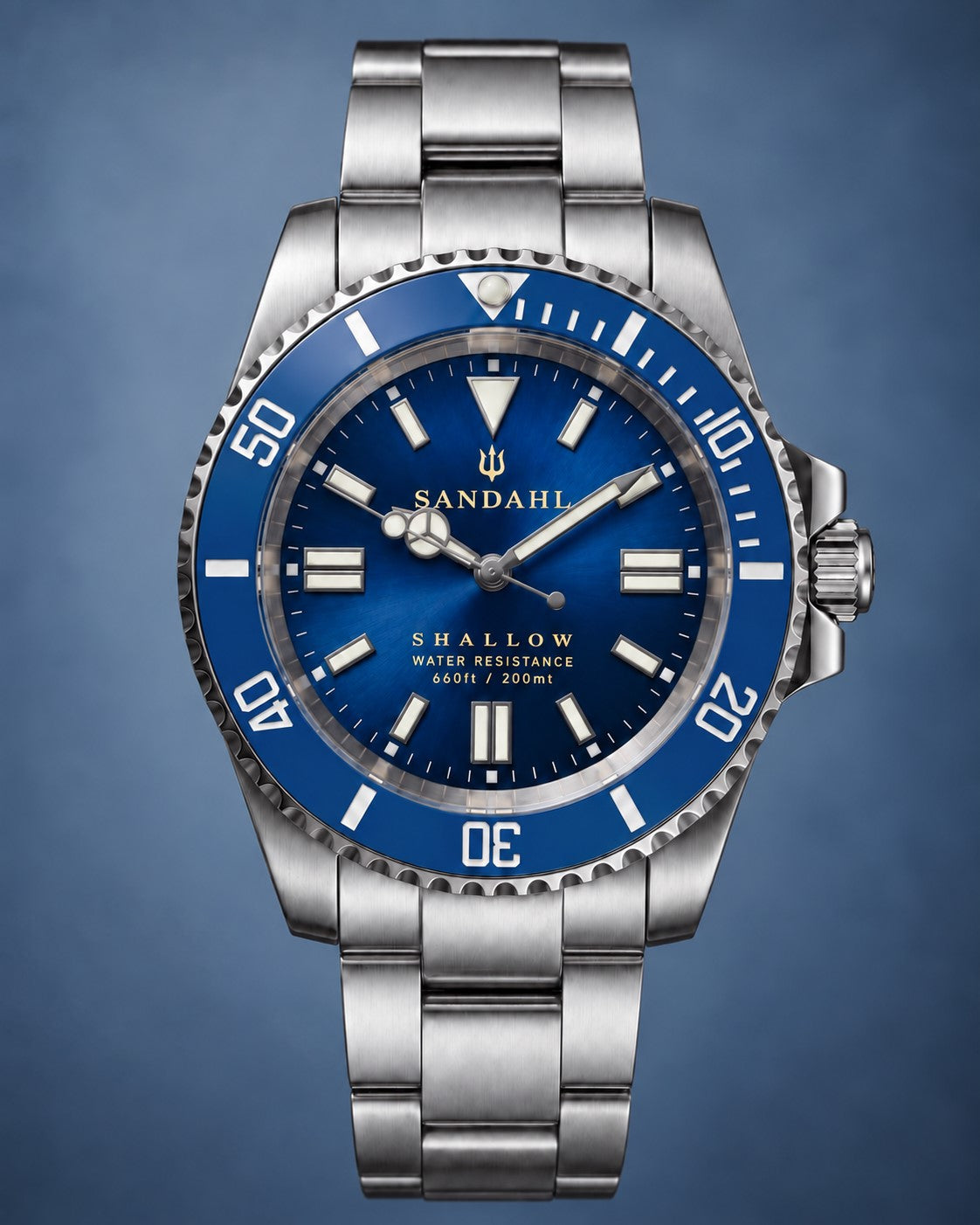

Article: From Pocket to Wrist

From Pocket to Wrist
At the end of the 19th century, the pocket watch was the natural companion for anyone who needed to keep track of time. It rested safely inside a waistcoat, often secured by a chain, and had become a symbol of order, responsibility and social standing.
But the world was changing. Aircraft were leaving the ground, automobiles were replacing horses, soldiers needed to coordinate their movements and people were travelling faster than ever before. Taking a pocket watch out with one hand suddenly became impractical.
Time needed to be immediately accessible.
The solution was to move the watch from the pocket to the wrist.
The First Watches Worn on the Wrist
The wristwatch did not begin as an obvious accessory for men. Throughout much of the 19th century, small watches attached to bracelets were primarily regarded as jewellery for women.
One famous early example was created by Patek Philippe in 1868. It was an ornate bracelet watch made for the Hungarian Countess Koscowicz and is regarded as Patek Philippe’s first wristwatch. Its construction demonstrated that a mechanical movement could be made small enough to be worn comfortably on the wrist.
Pocket watches nevertheless continued to dominate among men. Wristwatches were often considered too small and fragile. New environments and new demands were needed to change that perception.
Aviation Makes the Wristwatch Essential
One of the most important figures in the early history of the wristwatch was the Brazilian aviation pioneer Alberto Santos-Dumont.
While flying his early aircraft, he needed to check the time without releasing the controls. Taking out a pocket watch during a flight was both inconvenient and potentially dangerous.
In 1904, Louis Cartier therefore created a wristwatch for his friend. It featured a clear square dial that could be read at a glance. The model, later known as the Cartier Santos, became one of the first wristwatches designed for a specific practical purpose—and one of watchmaking’s earliest true design icons.
The wristwatch had begun its transformation from jewellery into an instrument.
War Changes Our Relationship with Time
The First World War marked the major breakthrough of the wristwatch among men.
On the battlefield, soldiers needed to coordinate troop movements, artillery fire and attacks. A pocket watch was difficult to use when both hands were needed for other tasks. Soldiers therefore began attaching smaller watches to their wrists with leather straps.
These early military wristwatches are commonly known as trench watches. They often featured clear numerals, luminous hands and protective metal guards over the glass. Details varied by maker and intended use.
When soldiers returned home, they brought the habit of wearing a watch on the wrist with them. The wristwatch was now associated with action, modernity and practical function. Within only a few years, it had evolved from a delicate fashion accessory into a natural part of a man’s everyday life.
The Wristwatch Finds Its Modern Form
During the years following the First World War, the wristwatch began to develop an identity of its own. It was no longer merely a converted pocket watch.
The Cartier Tank, designed in 1917, drew inspiration from the geometric lines of contemporary military tanks. With its rectangular case, the model demonstrated that a wristwatch could be modern, elegant and architectural.
Round cases also became increasingly common because their shape offered efficient protection for the movement. The case, strap and lugs began to be designed as one integrated whole.
A watch was now becoming more than a way to tell the time. It began to express the wearer’s personality, profession and way of life.
Water, Dust and an Active Life
When the watch moved from the pocket to the wrist, it was exposed to entirely new challenges. Rain, dust, perspiration and impacts could penetrate the case and damage the delicate movement.
In 1926, Rolex introduced the Oyster with a hermetically sealed case designed to protect the movement from water and dust.
In 1927, Mercedes Gleitze carried a Rolex Oyster during a swim in the English Channel. Rolex records that the watch remained in working order after more than ten hours in the water. The event became both a technical demonstration and an early example of how real human achievement could build trust in a watch model.
The Rolex Oyster changed expectations of what a wristwatch should be able to withstand. The watch no longer had to be protected from life—it could become part of it.
The Automatic Watch
The next major step was to make the watch self-winding.
Early automatic wristwatches were developed during the 1920s. By using the wearer’s movements, a rotating weight could wind the movement’s mainspring. In 1931, Rolex introduced its Perpetual system, featuring a rotor that could rotate through a complete circle around the movement. This principle became fundamental to the modern automatic watch.
For the wearer, it meant that the watch could remain running through the natural movements of everyday life. The technology created a closer relationship between human and machine: wrist movement could replenish its energy, although the amount of winding depended on activity.
The Watch Becomes a Professional Tool

Following the Second World War, new professions and leisure activities emerged. Aviation, motorsport, diving and international travel placed new demands on the wristwatch.
During the 1950s, several of the models that still define the modern sports watch were created.
The Blancpain Fifty Fathoms of 1953 was designed for professional divers and combined exceptional legibility, luminous markings, water resistance and a rotating diving bezel. In the same year, the Rolex Submariner was introduced, water-resistant to 100 metres and equipped with a rotating bezel for measuring elapsed time underwater. Together, these models helped establish the design principles that diving watches continue to follow today.
As jet travel made it possible to cross several time zones in a matter of hours, Rolex launched the GMT-Master in 1955. Its additional hand and graduated bezel allowed the wearer to read the time in two locations simultaneously. Developed as a navigational aid for airline crews, it came to symbolise the new international traveller.
In 1957, Omega introduced the Speedmaster, originally developed as a sports and racing chronograph. It would soon take on a far greater role.
The Watch Follows Humanity to the Moon

During the 1960s, NASA searched for a mechanical chronograph capable of withstanding the extreme conditions of space travel. The watches were subjected to dramatic temperature changes, vibrations, impacts and changes in atmospheric pressure.
The Omega Speedmaster passed the tests and was approved for crewed space missions. During Apollo 11 in 1969, the model became the first watch worn on the surface of the Moon, on Buzz Aldrin’s wrist.
The watch was not there as decoration. It served as an independent mechanical instrument in an environment where reliability and precise timing were essential. The event transformed the Speedmaster into a symbol of engineering, exploration and human courage.
In less than a century, the wristwatch had travelled from elegant salons to the trenches, from the depths of the ocean to the surface of the Moon.
1969 – The Year Quartz Changed Everything
The same year that humanity landed on the Moon, another event took place that would transform the entire watch industry.
On 25 December 1969, the Seiko Quartz Astron was launched as the world’s first commercially available quartz wristwatch. Instead of a traditional balance wheel, the watch used an electronically regulated quartz crystal vibrating at a highly stable frequency.
The result was a level of precision far beyond that of most mechanical wristwatches.
The technology was initially extremely expensive, but development progressed rapidly. During the 1970s, quartz watches became less expensive, thinner and easier to mass-produce.
The consequences were dramatic. Many traditional Swiss manufacturers struggled to compete, and a large number of companies disappeared. The period became known as the Quartz Crisis.
The watch had changed from a mechanical precision instrument into an electronic mass-market product.
The Digital Age
During the 1970s, watches began displaying time with numbers instead of hands.
The Hamilton Pulsar, introduced in 1972, became an early and widely recognised digital watch with a light-emitting diode display. At the press of a button, red numerals illuminated the screen. The watch appeared to be an object from the future and was worn by celebrities and technology enthusiasts alike.
More affordable LCD watches soon followed, offering continuous time display, alarms, illumination, stopwatches and calendars. For a new generation, the watch became more than a timekeeper—it was an electronic multifunctional tool.
In 1983, Casio launched the first G-SHOCK model, the DW-5000C. Its substantial, shock-resistant construction went against the prevailing trend towards increasingly thin watches and established an entirely new category: the exceptionally durable everyday watch.
That same year, the first Swatch watch was introduced. With only 51 components, automated production, bold colours and an accessible price, Swatch transformed the watch into a playful fashion object. People could own several and choose a watch to suit their clothing, mood or occasion. The model also contributed to the recovery of the Swiss watch industry.
Icons That Changed the Luxury Market
While quartz and digital technology continued to advance, the exclusive mechanical watch was also undergoing a transformation.

The Audemars Piguet Royal Oak of 1972 challenged conventional ideas of what a luxury watch should look like. It was made from steel, featured exposed screws and an integrated bracelet, yet carried a price comparable to that of gold watches. Designed by Gérald Genta, it helped establish the modern luxury steel sports watch.
A few years later, the Patek Philippe Nautilus followed, also designed by Genta. These models demonstrated that luxury did not have to be expressed exclusively through precious metals and discreet elegance. Construction, form, finishing and a distinctive identity could be equally important.
The Rolex Cosmograph Daytona gained unexpected cultural power through its association with actor and racing driver Paul Newman. His personal connection with the model helped make certain Daytona references some of the most sought-after collector’s watches in the world.
The people who wore these watches had become part of their history.
The Mechanical Renaissance
Once quartz watches had become inexpensive and exceptionally accurate, mechanical watches faced strong competition as everyday timekeepers.
Yet interest returned.
During the 1980s and 1990s, collectors and enthusiasts began rediscovering the qualities of mechanical watchmaking. Attention shifted from accuracy alone towards craftsmanship, construction, history and emotion.
A mechanical movement was not appreciated because it could outperform quartz in precision. It was appreciated because finely made components could work together using energy stored in a spring, without a microprocessor or battery.
The watch became one of the few mechanical objects still worn close to the body every day.
The Smartwatch – A Computer on the Wrist
During the 21st century, the wristwatch assumed yet another role.
Early connected watches were followed by models capable of receiving messages, recording exercise, measuring heart rate and communicating with a mobile phone. The Apple Watch went on sale in April 2015 and brought connected watches to a wider audience.
The watch became an extension of the phone and a tool for communication, health and activity. It no longer showed only the time—it monitored how people moved, worked and lived.
The same wrist that had once carried a simple mechanical watch displaying hours and minutes could now host a digital system capable of handling messages, payments, navigation and fitness data.
The Watch Today – More Than Time
Today, almost no one needs a wristwatch simply to know the time. It is available on phones, computers, cars and screens all around us.
Yet people continue to wear watches.
For some, the watch is a technical instrument. For others, it is a training companion, a piece of jewellery, a collector’s object or a reminder of a particular person or moment.
The mechanical watch offers something the digital world rarely can: a physical and understandable movement. Energy is stored in a spring, transferred through gears and released in a controlled rhythm. Every second is the result of materials, precision and human craftsmanship.
At the same time, smaller independent watch brands have made the market more diverse. New models can combine traditional mechanics with local production, individual ideas, modern materials and a distinct cultural identity.
From Necessity to Personal Expression
The history of the wristwatch is the story of changing human needs.
The pilot needed to read the time without releasing the controls. The soldier needed to coordinate movements. The diver needed to monitor time underwater. The traveller needed to follow multiple time zones. The astronaut needed an instrument that would function far from Earth.
Later, the market demanded greater precision, improved durability and digital information.
Today, we often choose a watch for a different reason: for what it represents.
From the pocket watch of the 19th century to the mechanical watch and smartwatch worn today, its form has changed many times. Yet its place has remained the same—close to the individual, present in everyday life and accompanying the moments that become part of our history.
Continue reading
From Sundials to Mechanical Time →
Discover the story behind SANDAHL →
Sources & further reading
- Patek Philippe Museum — the 1868 wristwatch
- Cartier — Santos and Tank design history
- Rolex — Oyster and Perpetual history
- Smithsonian National Air and Space Museum — the Apollo 11 Speedmaster
- Seiko — the 1969 Quartz Astron
- Hamilton — the Pulsar
- Casio — the original G-SHOCK
- Swatch — the original 51-component quartz watches
- Apple — Apple Watch launch announcement

Written by Per Sandahl
